The formulation challenge with Vitamin C is legendary. L-Ascorbic acid, while potent, is notoriously unstable and struggles to penetrate the skin’s lipid barrier, often causing irritation in the process. Ascorbyl Tetraisopalmitate (VC-IP), a next-generation esterified derivative, provides a definitive, science-backed solution to this dilemma. This guide offers a comprehensive examination of VC-IP’s chemistry, mechanism of action, and clinical evidence, establishing it as a premier choice for advanced skincare formulations.
1. What Is VC-IP? Definition & Chemical Identity
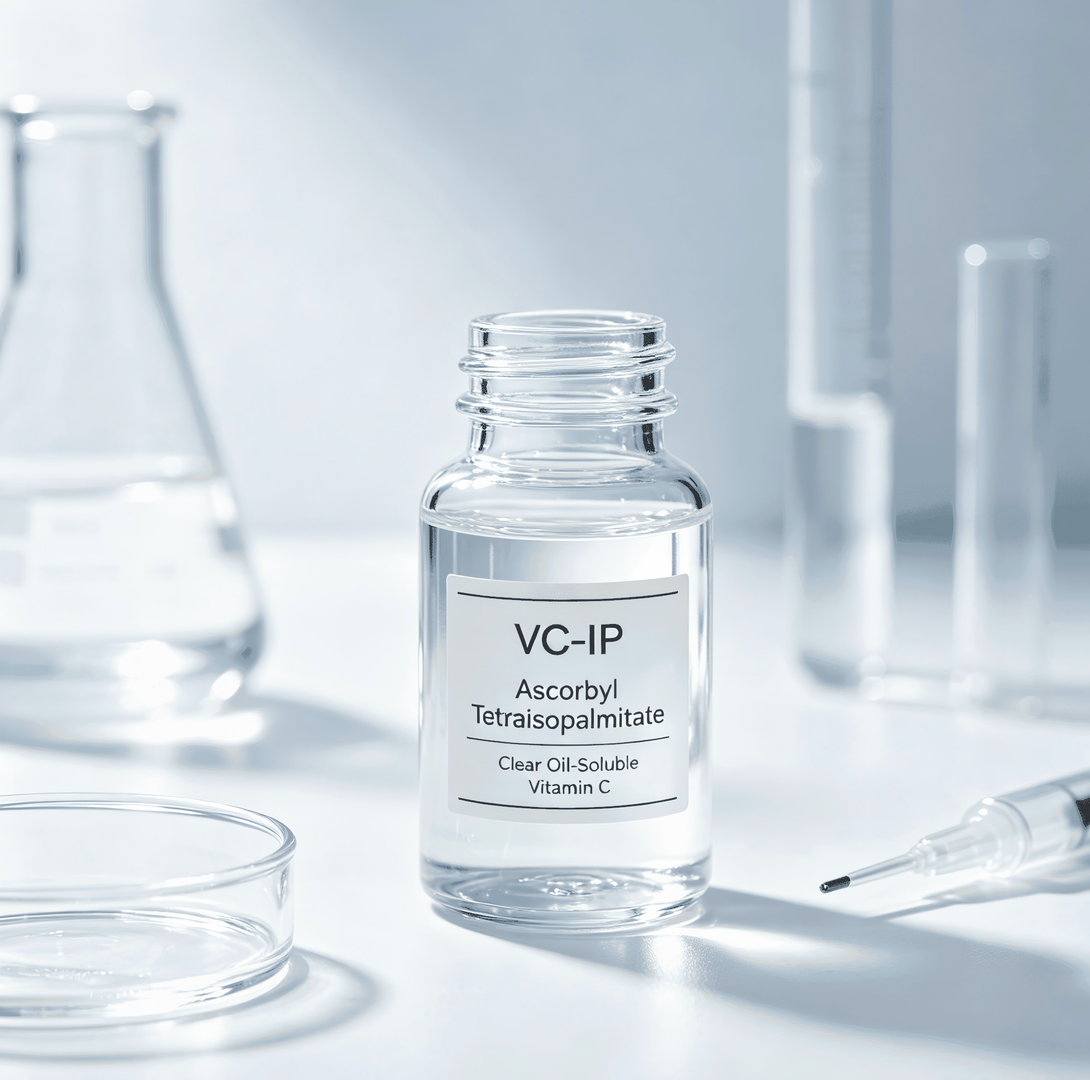
Ascorbyl Tetraisopalmitate (INCI name) is a lipophilic ester of L-ascorbic acid. Its chemical structure comprises a Vitamin C backbone esterified with four isopalmitic acid chains. This modification transforms the water-soluble Vitamin C into a highly stable, oil-soluble molecule. It is widely recognized by its synonym, Tetrahexyldecyl Ascorbate (THD Ascorbate), and commonly abbreviated as VC-IP.
| Parameter | Information |
|---|---|
| INCI Name | Ascorbyl Tetraisopalmitate |
| CAS No. | 183476-82-6 |
| Molecular Formula | C₇₀H₁₂₈O₁₀ |
| Molecular Weight | 1129.78 g/mol |
| Appearance | Colorless to pale yellow liquid |
| Solubility | Oil-soluble (soluble in esters, hydrocarbons, vegetable oils); insoluble in water and glycols. |
2. The Formulator’s Challenge & The VC-IP Solution
The Problems with Traditional Vitamin C
- Extreme Instability: L-ascorbic acid rapidly oxidizes upon exposure to light, heat, and air, leading to degradation and loss of efficacy.
- Poor Skin Penetration: As a hydrophilic molecule, it struggles to cross the skin’s lipophilic stratum corneum, resulting in low bioavailability.
- Formulation & Irritation Issues: It requires a very low pH (< 3.5) to remain stable, which can cause significant skin stinging and irritation, limiting its use in sensitive skin formulations.
The VC-IP Solution
VC-IP overcomes these challenges through its unique chemistry:
- Exceptional Stability: The esterification of the reactive hydroxyl groups provides robust resistance to oxidation and heat. Studies show it retains >98% purity even under accelerated stability testing conditions.
- Enhanced Bioavailability: Its lipophilic nature allows it to penetrate the skin’s lipid barrier efficiently, achieving 14 times higher intracellular Vitamin C levels than an equivalent dose of L-ascorbic acid.
- Gentle & Formulation-Friendly: VC-IP is non-irritating and can be formulated at a more skin-friendly pH (< 6.0), making it suitable for all skin types, including sensitive skin.
3. Mechanism of Action
VC-IP functions as a highly effective pro-vitamin C through a two-step delivery system:
- Superior Skin Penetration: Due to its lipophilic tetra-isopalmitate chains, VC-IP efficiently penetrates the skin’s lipid barrier.
- Enzymatic Activation: Once absorbed, cellular esterases cleave the isopalmitate groups, releasing free L-ascorbic acid to exert its biological effects.
Key Biological Pathways Activated by Released Vitamin C
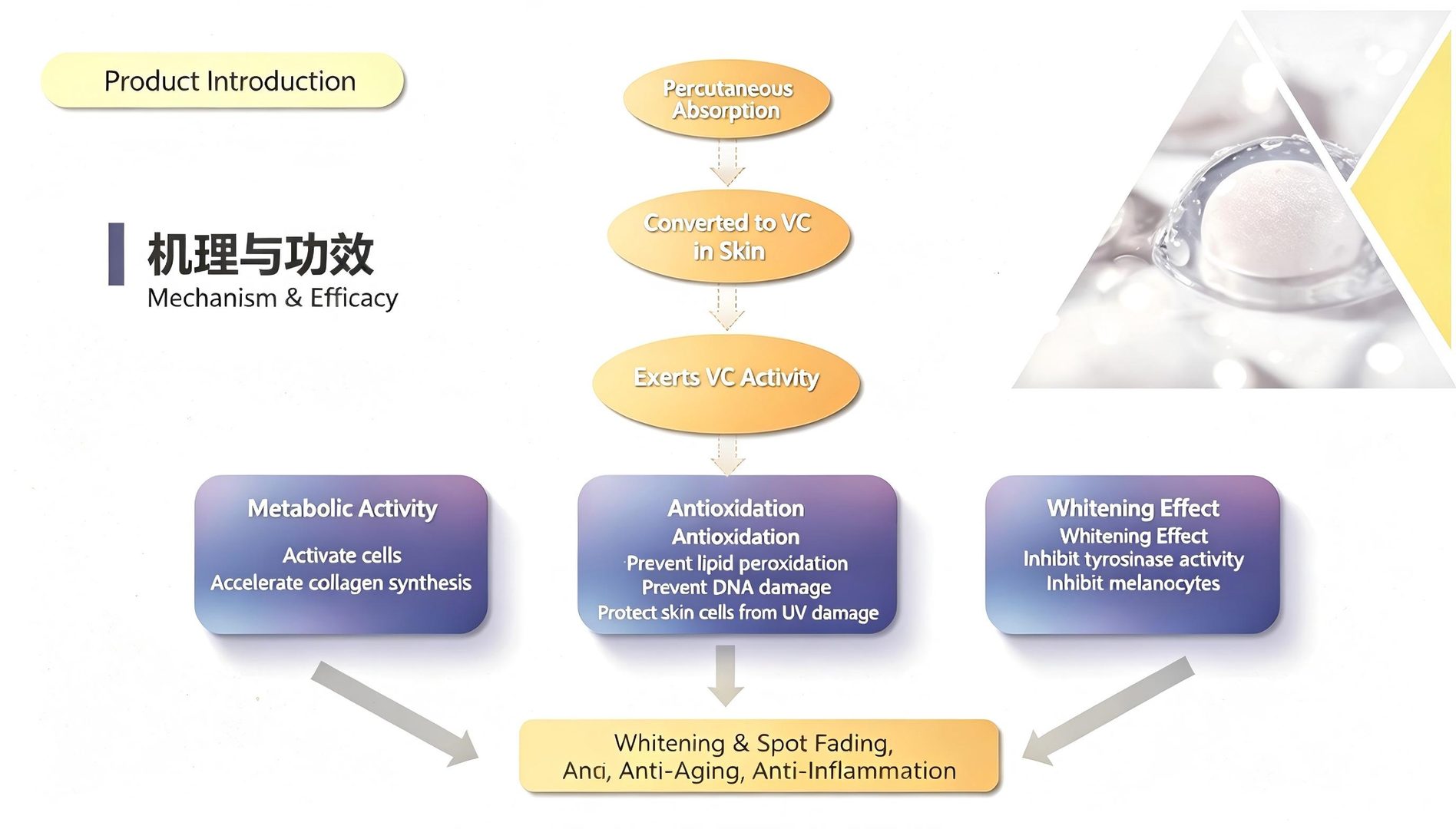
- Potent Antioxidant Activity: Neutralizes reactive oxygen species (ROS) and protects cells from UV-induced oxidative stress.
- Inhibition of Melanogenesis: Suppresses tyrosinase activity, reducing melanin synthesis and pigment production.
- Collagen Synthesis Support: Serves as a cofactor for prolyl hydroxylase, essential for stabilizing the collagen triple helix, promoting collagen production and combating photodamage.
- Anti-Inflammatory Action: Reduces the production of pro-inflammatory cytokines.
4. Key Data & Evidence
4.1 Efficacy Data Summary
| Study/Parameter | Result/Comparison |
|---|---|
| Cellular Uptake | VC-IP shows approximately 14 times more intracellular Vitamin C accumulation than L-ascorbic acid at equivalent doses in human skin fibroblasts. |
| Collagen Synthesis | VC-IP at 20-50 μM enhanced collagen synthesis in human dermal fibroblasts by 170%–195%, compared to 112%–127% for L-ascorbic acid at the same concentration. |
| MMP Inhibition | VC-IP demonstrates superior anti-aging activity by reducing the residual activity of MMP-2 and MMP-9 to only 18–23% and 10–17% of baseline levels, respectively. This significantly outperforms L-Ascorbic Acid, which leaves 39–46% (MMP-2) and 42–52% (MMP-9) residual activity under the same test conditions. |
| In-Vivo Efficacy | A clinical study with a 2% VC-IP cream demonstrated significant improvements in skin lightening, hydration, elasticity, and reduced skin roughness and TEWL (transepidermal water loss) over 4 weeks. |
4.2 Safety & Toxicology Profile
| Test/Endpoint | Result |
|---|---|
| Acute Oral Toxicity | LD₅₀ > 2000 mg/kg (Low toxicity) |
| Skin Irritation | Non-irritating |
| Skin Sensitization | Non-sensitizing at 10% in humans |
| Genotoxicity | Non-mutagenic (Ames test negative) |
| Phototoxicity | Non-phototoxic |
| Conclusion: The established safety profile confirms VC-IP as a safe, well-tolerated ingredient with a very low irritation potential. |
5. Regulatory Status
| Region | Status |
|---|---|
| China | ✅ Permitted (IECIC) |
| European Union | ✅ Permitted (CosIng) |
| United States | ✅ Permitted |
| Japan | ✅ Permitted (Quasi-drug active ingredient approved in 2006) |
| South Korea | ✅ Permitted (Listed as a functional ingredient for skin lightening) |
| Taiwan, China | ✅ Permitted (Approved medicated cosmetic ingredient) |
6. Summary Comparison: VC-IP vs. Traditional Vitamin C
| Feature | VC-IP (Ascorbyl Tetraisopalmitate) | L-Ascorbic Acid (Pure Vitamin C) |
|---|---|---|
| Stability | High – Resists oxidation and degradation | Very Low – Rapidly degrades in light, heat, and air |
| Solubility | Oil-Soluble (excellent skin penetration) | Water-Soluble (limited skin penetration) |
| Skin Penetration | Excellent – Achieves much higher cellular levels | Poor – Barrier limits absorption |
| Irritation Potential | Low – Non-irritating, suitable for sensitive skin | High – Requires low pH, causing stinging and irritation |
| Formulation pH | Flexible (works well at pH <6) | Restricted (must be below pH 3.5) |
7. Frequently Asked Questions
Q1: Is VC-IP a direct replacement for pure Vitamin C?
A: VC-IP is a stable, bioavailable precursor (pro-vitamin C). It penetrates the skin and is converted to active L-ascorbic acid, delivering the full spectrum of Vitamin C benefits with superior stability and tolerability.
Q2: Is VC-IP safe for sensitive skin?
A: Yes. VC-IP is well-known for its low irritation profile. It is classified as non-irritating and non-sensitizing, making it an excellent choice for sensitive skin.
Q3: What is the recommended usage level for VC-IP?
A: While safe up to higher levels, the recommended usage in cosmetic formulations is typically between 1% and 5% for optimal efficacy and safety.
Q4: What is the shelf life of VC-IP?
A: When stored properly in a cool, dry, sealed container away from light, VC-IP exhibits excellent stability and maintains its quality for up to 3 years under recommended conditions.
Resources & Support
This guide is part of our commitment to providing in-depth technical knowledge for formulators.
- Looking for samples or formulation support? Our team of application chemists can help you integrate VC-IP into your products. [Contact Our Team]
- Need technical documentation? Access our comprehensive library of COAs, TDS, and safety data. [Request Documents]
- Related Reading:
- [Link to VC-IP Formulation Guide →]
- [Link to Vitamin C Derivatives Comparison →]
- [View full product specifications & request a quote →]