Ascorbyl Tetraisopalmitate (VC-IP) is a stable, oil-soluble Vitamin C derivative that offers significant advantages over traditional forms (see our [VC-IP Science Guide] for full details). However, to unlock its full potential in a finished product, it requires a nuanced understanding of its behavior in different systems. This guide provides R&D professionals with advanced formulation strategies, detailed compatibility data, and troubleshooting advice for VC-IP.
1. Understanding VC-IP’s Solubility Profile
VC-IP is an oil-soluble liquid that dissolves readily in most cosmetic oils, esters, and hydrocarbons. It is, however, completely insoluble in water, glycerin, propylene glycol, and other polyols. This solubility profile is the primary driver for its formulation:
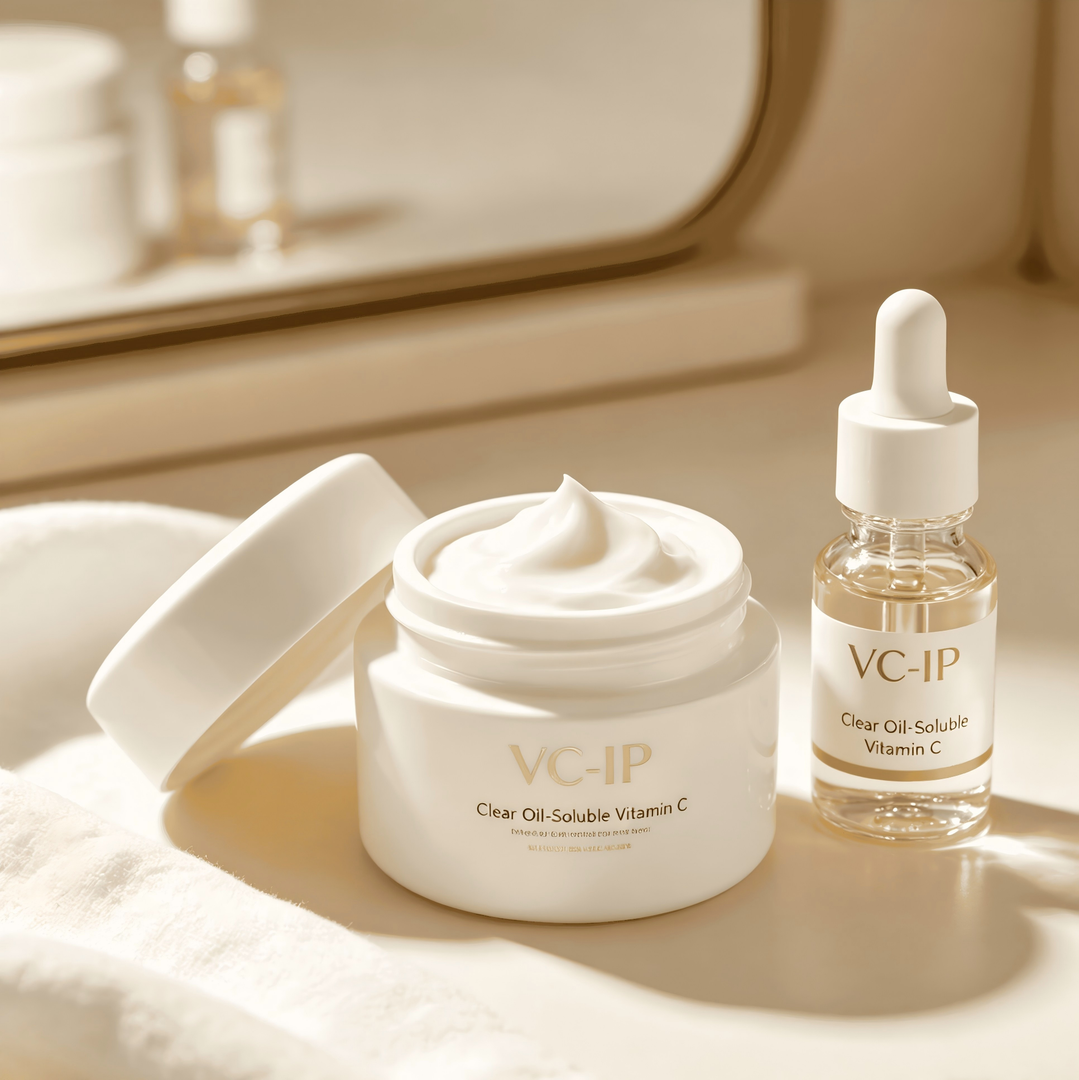
- Oil Phase Addition: The most common and robust method is to dissolve VC-IP in the oil phase of your emulsion.
- Anhydrous Systems: VC-IP is an ideal active for anhydrous serums, balms, and oils due to its liquid nature and stability.
- Solubilization in Water-Based Gels: For clear gel serums, VC-IP must be solubilized using an appropriate solubilizer (e.g., PEG-40 Hydrogenated Castor Oil) or a nano-emulsion system. This can be challenging; a study found that a liposomal dispersion system significantly enhances its penetration in such formulations.
2. Optimizing for Stability
While VC-IP is highly stable, its longevity can be further extended with best practices:
- pH Management: The primary rule is to keep the final formulation pH below 6.0. Do not attempt to adjust the pH after adding VC-IP, as alkaline conditions can trigger hydrolysis and degradation.
- Protection from Oxidation:
- Use Chelating Agents: Add 0.05% – 0.1% of a chelator like Disodium EDTA to sequester metal ions (e.g., iron, copper) that can catalyze oxidation.
- Include Co-Antioxidants: Synergistic antioxidants like Tocopherol (Vitamin E) and Ferulic Acid can be added to the oil phase to protect the formula and enhance overall antioxidant capacity.
- Processing: Add VC-IP to the formulation at room temperature or during the cooling phase (below 60°C) after emulsification. Avoid prolonged exposure to high heat.
3. Compatibility and Formulation Tips
- Compatibility: Generally compatible with most cosmetic ingredients. Avoid strong oxidizing agents and inorganic sunscreens (like ZnO or TiO₂) that are coated with pro-oxidative metal ions.
- In-Use Stability: For formulations with a pH near 7.0, it is critical to use robust antioxidant and chelating systems to ensure product integrity over its shelf life.
4. Troubleshooting Common Issues
| Issue | Possible Cause & Solution |
|---|---|
| Discoloration (Yellowing) | Oxidation. Check pH (should be <6.0). Add or increase chelating agent and antioxidant (e.g., Tocopherol). Ensure raw materials and packaging are free from metal contaminants. |
| Poor Clarity in Water-Based Gels | VC-IP is not fully solubilized. Try using a more powerful solubilizer or switch to a nano-emulsion/liposomal delivery system. |
| Crystallization in Anhydrous Oils | Concentration may be too high for the chosen oil phase. Re-evaluate the solubility of VC-IP in your specific oil blend. |
5. Suggested Reference Formulations (Starting Points)
Basic Whitening & Anti-Aging Serum (O/W Emulsion)
- Phase A (Oil Phase): C12-20 acid PEG-8 ester (e.g., Xalifin 15) – 16%, Propylene glycol – 10%, VC-IP – 2-5%, Tocopherol – 0.2%.
- Phase B (Water Phase): Water q.s. to 100%, Glycerin – 7.5%, EDTA-2Na – 0.05%.
- Phase C: Preservative (e.g., Phenoxyethanol & Ethylhexylglycerin) – 0.85%.
- Process: Heat Phase A and B separately to 70-75°C. Add B to A with homogenization. Cool to 45°C and add Phase C. Ensure final pH is below 6.0.
Resources & Support
- Need a custom formulation or samples? Our R&D team can help you develop stable, effective VC-IP products. [Contact Our Team]
- Looking for more formula ideas? Download our complete VC-IP Formulation Guide (PDF). [Request Document]
- For detailed specifications and bulk ordering: [Visit HUACHEM® VC-IP Product Page →]
- Related Reading: [VC-IP Formulation Guide] | [Vitamin C Derivatives Comparison]