Selecting the right Vitamin C derivative for a formulation is a critical decision. While all provide antioxidant benefits, their properties differ dramatically. For a detailed explanation of VC-IP’s mechanism of action, please see our [complete VC-IP Science Guide]. This analysis provides a data-driven comparison of three leading forms: the gold-standard but problematic L-Ascorbic Acid (L-AA), the stable and popular 3-O-Ethyl Ascorbic Acid (EAA), and the premium oil-soluble Ascorbyl Tetraisopalmitate (VC-IP).
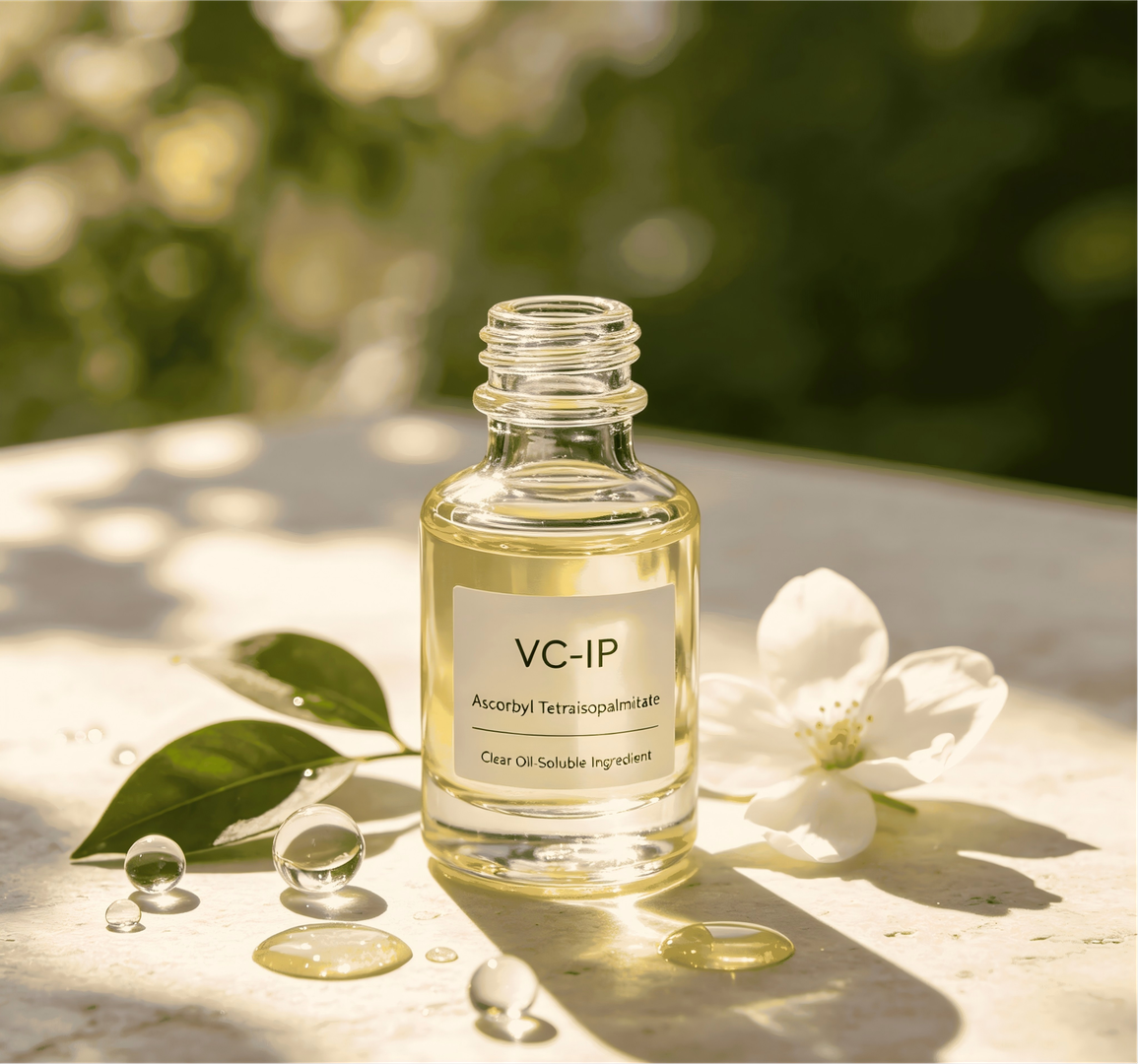
1. Chemical & Physical Properties at a Glance
| Feature | L-Ascorbic Acid (L-AA) | 3-O-Ethyl Ascorbic Acid (EAA) | Ascorbyl Tetraisopalmitate (VC-IP) |
|---|---|---|---|
| Chemical Class | Pure, water-soluble Vitamin C | Etherified derivative (water-soluble) | Esterified derivative (oil-soluble) |
| Stability | Very Poor | Good (better than L-AA) | Excellent |
| Skin Penetration | Poor (hydrophilic) | Good (moderate lipophilicity) | Excellent (highly lipophilic) |
| Activation | Directly active | Requires enzymatic conversion | Requires enzymatic conversion |
| Irritation Potential | High (low pH required) | Low | Very Low / Non-irritating |
| Formulation pH | < 3.5 | 4.5 – 6.5 | < 6.0 |
2. Comparative Efficacy Data
| Function | L-Ascorbic Acid | 3-O-Ethyl Ascorbic Acid | VC-IP (Ascorbyl Tetraisopalmitate) | Key Insight |
|---|---|---|---|---|
| Collagen Synthesis | +112% ~ +127% | Literature indicates enhancement¹ | +170% ~ +195% | VC-IP shows superior collagen-boosting activity. |
| MMP-2 Residual Activity | 39% – 46% | Data not directly comparable | 18% – 23% | Lower residual activity = stronger inhibition. VC-IP is significantly more effective. |
| MMP-9 Residual Activity | 42% – 52% | Data not directly comparable | 10% – 17% | VC-IP almost completely inhibits MMP-9 activity, far outperforming L-AA. |
| Skin Penetration | Low | Moderate | Highest (14x more VC than L-AA) | VC-IP delivers substantially more active to the skin. |
¹ Literature reference value, not tested under identical in-vitro conditions as VC-IP & L-AA in this summary.
3. Formulator’s Verdict
- Choose L-Ascorbic Acid if: You are formulating a classic, low-pH, water-based serum for experienced users who can tolerate potential irritation and you are fully prepared to manage its stability with complex packaging and strict cold-chain storage.
- Choose 3-O-Ethyl Ascorbic Acid if: You need a stable, water-soluble derivative that is less irritating than L-AA and can be used in simple water-based gels.
- Choose VC-IP if: You are formulating a premium, stable, and gentle product for a wider consumer base. Its superior penetration, efficacy, and unparalleled stability, combined with a low irritation profile, make it the most versatile and patient-friendly choice. It is particularly advantageous for oil-based serums, emulsions, and anhydrous systems, where it dissolves readily and remains highly active.

4. Conclusion
When evaluated against the key performance indicators of stability, penetration, and efficacy, VC-IP demonstrates a clear and significant advantage. While L-AA remains a classic option, its formulation challenges and irritation potential are substantial. VC-IP offers the ideal balance of a high-performing, stable, and gentle active, making it the superior choice for modern, sophisticated skincare formulations.
Resources & Support
- Ready to formulate with VC-IP? Request a free sample and technical documentation. [Contact Our Team]
- Read related:
[Link to VC-IP Formulation Guide]
VC-IP Formulation Guide: Tips, Compatibility & Troubleshooting